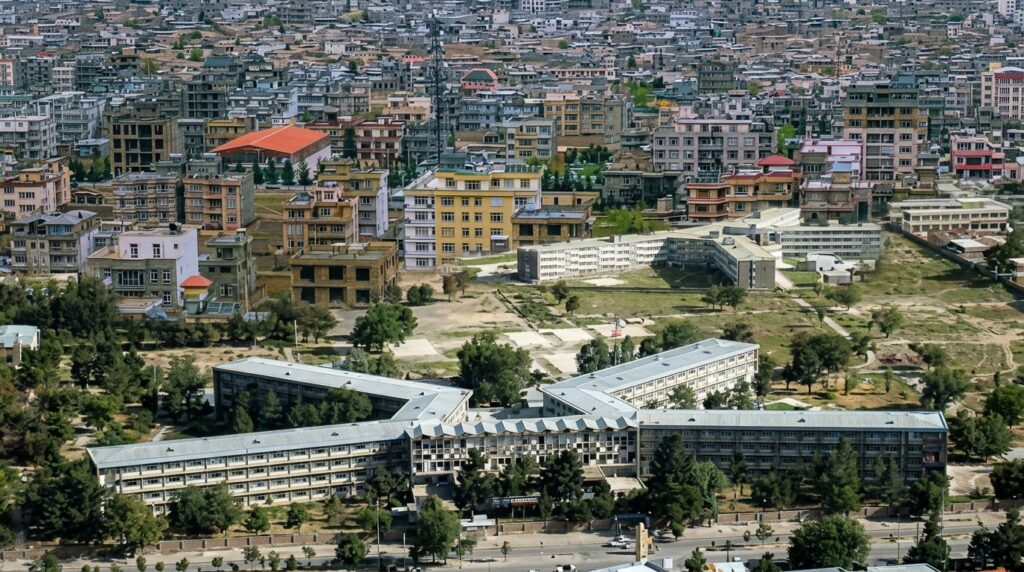
The Supreme Council of National Resistance for the Salvation of Afghanistan strongly condemns the eviction of residents from Omid Sabz Township, the seizure of citizens’ homes and properties, and the removal of the historically significant and identity-defining term “Parsi” (Persian) from the signboard of the Faculty of Languages and Literature at Kabul University.
The Council considers these actions part of a broader pattern of discriminatory policies, the systematic erasure of cultural identities, and violations of the fundamental rights of the people of Afghanistan.
The Taliban’s actions in forcibly evicting families from their homes and properties in Omid Sabz Township, Nawabad Township in Ghazni, and several other residential communities across various provinces of Afghanistan constitute clear violations of property rights, human dignity, and internationally recognized human rights principles.
Such actions do not serve justice. Rather, they demonstrate the continuation of policies based on coercion, the deprivation of citizens’ rights, and the unilateral imposition of authority over the lives and future of the Afghan people.
Furthermore, the removal of the term “Parsi” from the signboard of the Faculty of Languages and Literature at Kabul University represents an assault on Afghanistan’s historical, cultural, and linguistic heritage.
The Persian language is an inseparable part of Afghanistan’s civilizational history and a shared cultural heritage of millions of its citizens. No political movement or ideological group can alter the historical and cultural realities of a nation simply by removing a word.
The Supreme Council of National Resistance for the Salvation of Afghanistan believes that the Taliban, through their continued pursuit of exclusionary policies, discrimination, restrictions on fundamental freedoms, and disregard for citizens’ rights, have plunged Afghanistan into increasingly severe political, social, and humanitarian crises.
Policies rooted in exclusion, fear, and deprivation can neither establish lasting stability nor create the conditions necessary for national unity and solidarity.
We call upon the United Nations, the United Nations Human Rights Council, the UN Special Rapporteur on the Situation of Human Rights in Afghanistan, the Organization of Islamic Cooperation (OIC), the European Union, and all relevant international institutions to refrain from remaining silent in the face of violations of the rights of the Afghan people, forced evictions, deprivation of property rights, and attacks on the country’s cultural and linguistic identity.
We urge these organizations to take effective, responsible, and meaningful measures to protect and support the people of Afghanistan.
The Supreme Council of National Resistance for the Salvation of Afghanistan once again emphasizes that Afghanistan’s future can only be secured through justice, the genuine participation of all citizens, respect for ethnic, linguistic, and cultural diversity, and the establishment of a political system founded upon the freely expressed will of the people.
No force, through coercion, discrimination, or exclusion, will ever succeed in silencing Afghanistan’s historical identity or suppressing the legitimate aspirations and fundamental rights of its people.