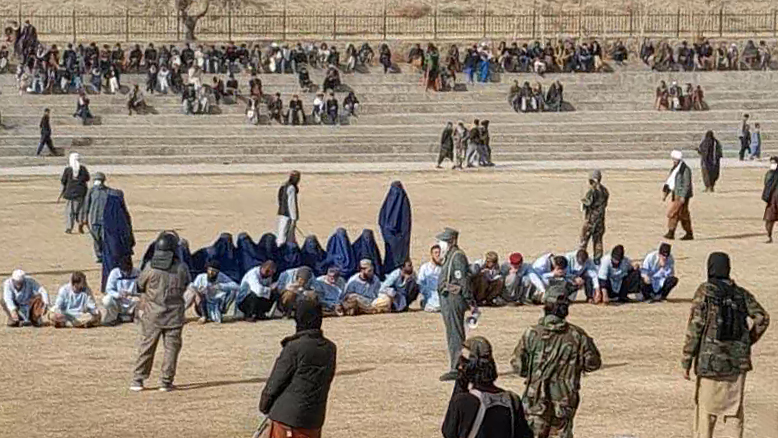
The Supreme Council of National Resistance for the Salvation of Afghanistan condemns in the strongest terms the continuation of the Taliban’s policies of repression, discrimination, monopolization, widespread violations of the fundamental rights and freedoms of the Afghan people, and the group’s recent actions. The Council considers these actions part of an organized policy aimed at consolidating authoritarian rule, systematically eliminating public freedoms, destroying scientific, cultural, and civil institutions, and depriving citizens of their most basic human and civil rights.
The Taliban have not only failed to demonstrate any willingness to ensure justice, genuine participation of all ethnic groups and segments of society, respect for human dignity, and the fundamental rights of citizens, but through the continuation of policies of exclusion, discrimination, repression, intimidation, and monopolization, they have driven Afghanistan toward international isolation, the collapse of national institutions, increasing poverty and unemployment, forced migration, humanitarian crisis, and growing instability.
The Supreme Council of National Resistance emphasizes that the continuation of this approach not only poses a serious threat to Afghanistan’s future and the country’s national interests, but also exposes regional security and stability to increasing risks. Responsibility for all political, economic, social, and humanitarian consequences arising from these policies rests directly with the Taliban, and the group cannot evade accountability before the people of Afghanistan and the international community.
The Taliban’s recent decision to close Khatam al-Nabieen University and all of its branches, despite the university holding an official operating license from the Ministry of Higher Education, is an arbitrary action lacking any legal justification and constitutes a clear manifestation of hostility toward knowledge, education, and the independence of academic institutions. This action has harmed thousands of students, professors, and their families and demonstrates that, instead of supporting the country’s scientific development, the Taliban are taking steps toward dismantling Afghanistan’s educational, research, and intellectual infrastructure. Furthermore, the removal of law and political science programs from Afghanistan’s universities represents a continuation of the same organized Taliban policy aimed at weakening the higher education system, undermining the humanities, restricting critical thinking, and depriving the younger generation of specialized education in the fields of law, justice, governance, and politics. The consequences of such a policy will include weakening the rule of law, diminishing the country’s scientific and academic capacities, and depriving Afghanistan of qualified and committed professionals in the legal and political fields.
The Supreme Council of National Resistance also strongly condemns the intensification of restrictions on free media, the closure of independent media outlets, the arrest, threatening, and intimidation of journalists, and the expansion of censorship. Freedom of expression and freedom of the press are among the most fundamental rights of nations, and a group that silences the voices of its critics through force and repression lacks moral and political legitimacy among the people.
Repeated reports concerning the discovery of bodies, a series of killings, enforced disappearances of citizens, and particularly reports regarding the discovery of the bodies of a number of residents of Panjshir Province have caused serious concern among the Afghan public. Reports of deliberate killings and torture of local residents, blatant violations of people’s privacy and security, summary executions, and the killing of sons before the eyes of their fathers—including cases in which women and children have also been exposed to violence, threats, and harm—further underscore the need for immediate and comprehensive investigation. The High Council of National Resistance calls for independent, transparent, and impartial investigations by international institutions to establish the truth and hold the perpetrators and those who ordered these acts accountable. No crime should remain concealed by silence or protected by impunity.
Through discriminatory and monopolistic policies, the Taliban have extensively violated the rights of Afghanistan’s ethnic groups, religious communities, and all citizens. By systematically excluding ethnic and religious communities, national figures, and political forces from the administration of the country, they have placed national unity, social cohesion, and public trust under serious threat.
Depriving girls and women of the right to education, higher education, employment, social participation, and presence in public life is one of the clearest examples of violations of fundamental human rights in Afghanistan. Depriving millions of girls of education has sacrificed the country’s future to extremist thinking and diverted Afghanistan from the path of development, progress, justice, and human flourishing.
By banning the activities of political parties, repressing civil society institutions, restricting universities and scientific centers, silencing free media, and eliminating citizens’ political participation, the Taliban have effectively targeted all the pillars of a free, law-governed, and democratic society. The group’s opposition to freedom of thought, freedom of expression, women’s rights, university independence, and the activities of political parties reflects its authoritarian, monopolistic, and anti-people character.
The Supreme Council of National Resistance also expresses serious concern regarding existing reports and concerns about the presence and activities of terrorist groups in Afghanistan and their implications for the security of Afghanistan, the region, and the world. It calls for transparency, accountability, and adherence to international commitments in the fight against terrorism.
The Supreme Council of National Resistance for the Salvation of Afghanistan calls upon the United Nations, the Human Rights Council, the Organization of Islamic Cooperation, countries of the region and the wider international community, and all international institutions dedicated to the protection of human rights not to remain silent in the face of continuing human rights violations, the repression of fundamental freedoms, systematic discrimination, the destruction of scientific and civil institutions, and the continuation of the Taliban’s authoritarian policies. The Council urges them to use all available legal, political, and diplomatic mechanisms to hold the Taliban accountable and compel the group to respect the fundamental rights of the Afghan people.
The Supreme Council of National Resistance reiterates that Afghanistan belongs to all of its citizens and that no group has the right to hold the destiny of an entire nation hostage through force, authoritarianism, monopolization, discrimination, and repression. Afghanistan’s future can be secured only through the supremacy of law, respect for human dignity, protection of women’s rights, freedom of the media, independence of universities, free activity of political parties, equal participation of all ethnic and religious communities, the establishment of justice, and the formation of a legitimate and inclusive system based on the free will of the people.